
Learn how OGMP 2.0 reporting works, what Level 5 requires, and how site-level methane measurement supports reconciliation and emissions management.
Read time: 7 minutes
As the year begins to wind down, many oil and gas operators are looking ahead to annual emissions reporting and evaluating the methane data collected across their assets throughout the year. For companies participating in the Oil and Gas Methane Partnership 2.0 (OGMP 2.0), that process means wrapping up measurement campaigns and working on their measurement-informed reporting.
Managed by the United Nations Environment Programme’s International Methane Emissions Observatory (IMEO), OGMP 2.0 is a global measurement-based methane reporting framework for the oil and gas industry. Member companies commit to annual methane emissions reporting across operated and non-operated assets, alongside an implementation plan for progressing toward or maintaining Gold Standard reporting.
At the highest reporting level, Level 5, operators bring together source-level emissions information and site-level measurements through a process known as reconciliation. Beyond simply to collecting more methane data, the objective is to build a complete and defensible understanding of where emissions are occurring, how large they are, and how different measurement and estimation approaches compare – all in an effort to continually improve and reduce emissions to the atmosphere.
What Is OGMP 2.0?
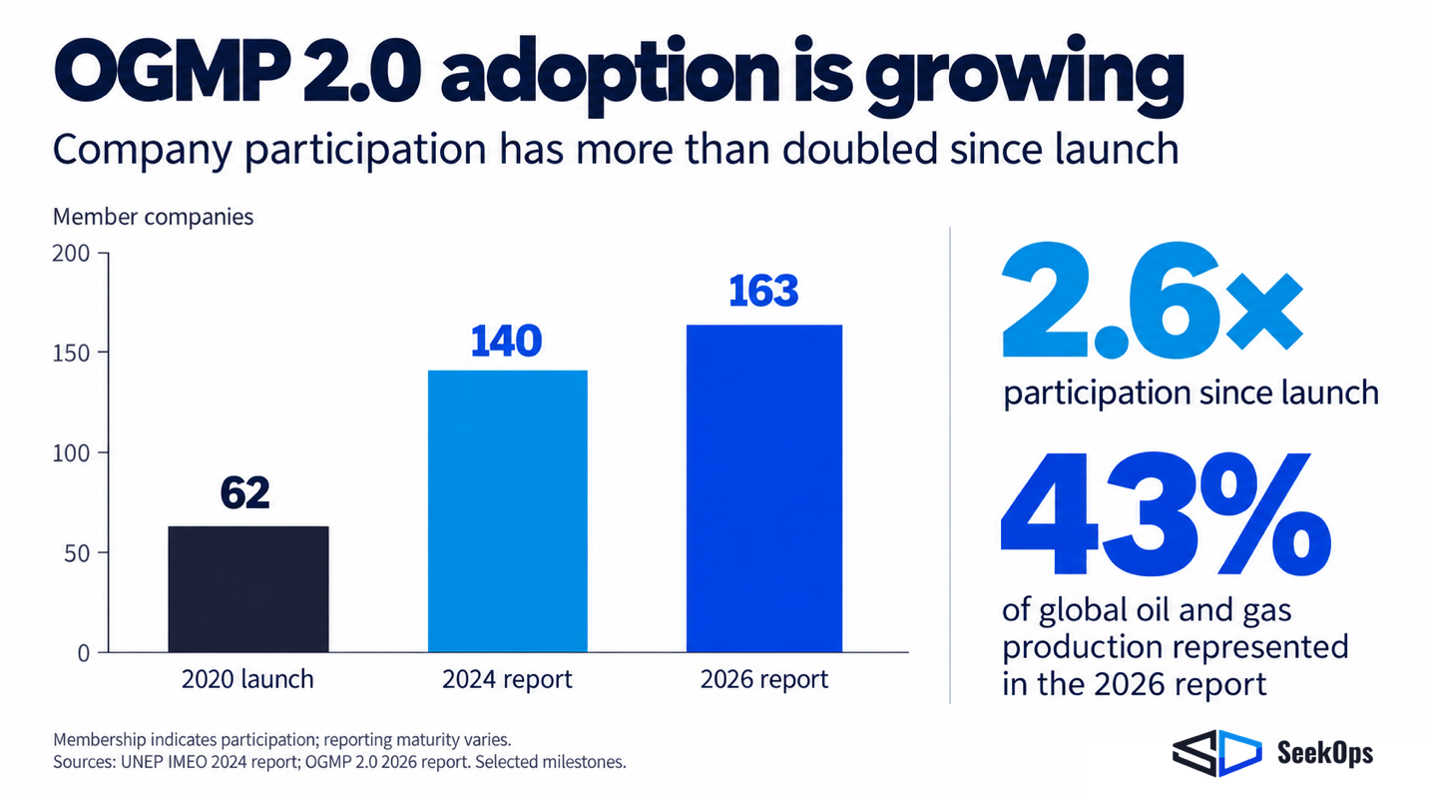
OGMP began in 2014 and was expanded into OGMP 2.0 in 2020, significantly increasing the scope and ambition of the framework. Today, UNEP describes OGMP 2.0 as its flagship oil and gas methane reporting and mitigation program and a global standard for measurement-based methane emissions reporting.
Unlike a regulatory requirement, OGMP 2.0 is a voluntary reporting framework where individual operators apply for membership to participate. However, its influence increasingly extends beyond voluntary corporate reporting. UNEP published guidance in late 2025 specifically addressing how countries can incorporate OGMP 2.0-aligned reporting into methane measurement, reporting and verification (MRV) regulations, reflecting growing interest in using the framework as a foundation for methane policy. This is more recently demonstrated with the EU’s methane regulation policy that specifically includes reference to OGMP 2.0 as a required reporting methodology.
OGMP 2.0 covers direct methane emissions across the oil and gas value chain within its defined scope, including emissions from intentional venting, unintentional leaks and incomplete combustion (e.g. emissions from flaring, turbines, compressors). Its central premise is that methane reporting should progressively move toward more granular, measurement-based information. That progression is then captured through five reporting levels.
Understanding the Five OGMP 2.0 Reporting Levels
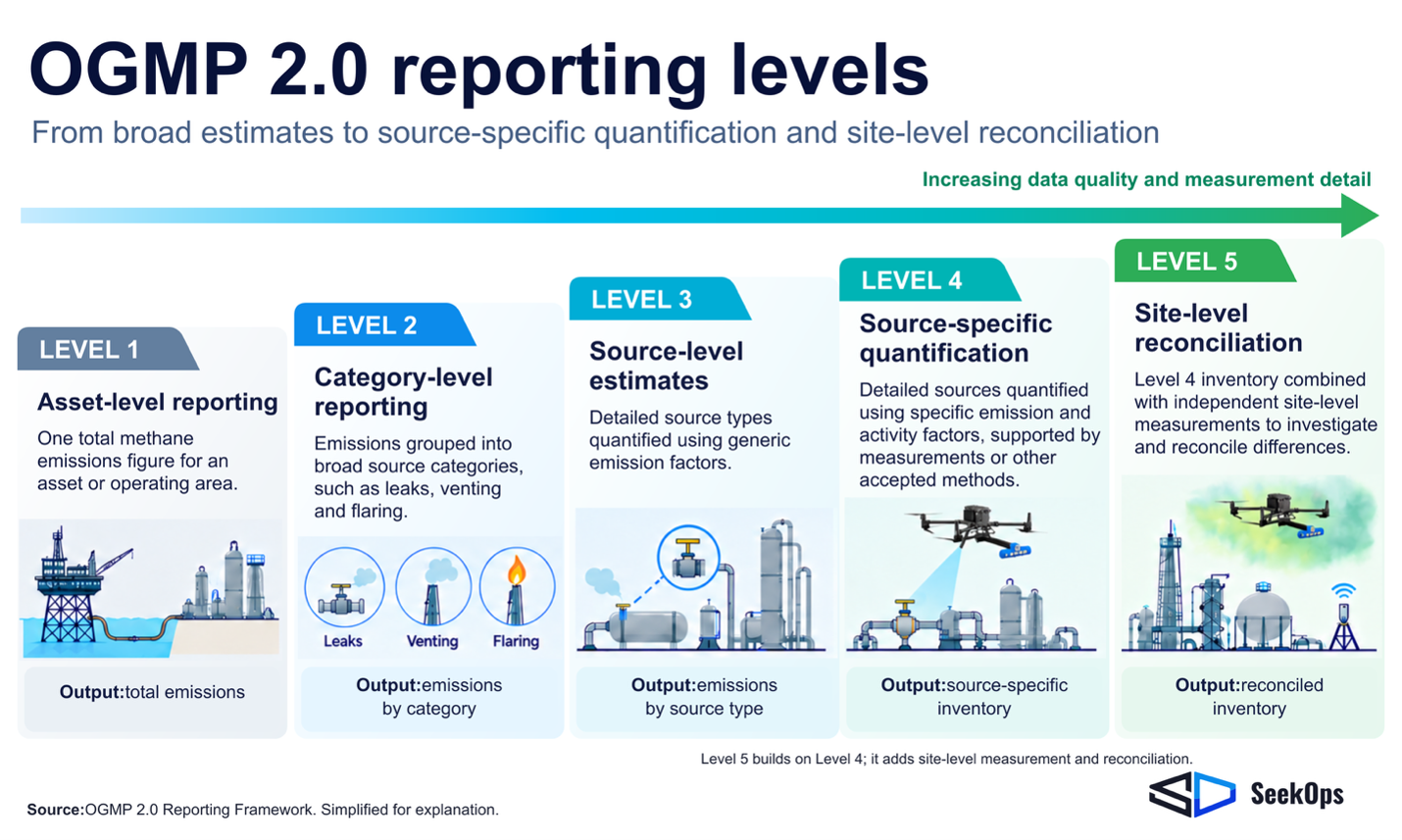
The OGMP 2.0 framework is designed so that the quality and granularity of methane information increases as operators move through the reporting levels.
Level 1 reports emissions at the asset or venture level with limited source-level detail.
Level 2 reports emissions by broad source category using generic emissions factors.
Level 3 moves to individual source-level reporting using generic emission factors.
Level 4 uses specific emissions factors and/or direct measurements to quantify emissions at the individual source level.
Level 5 adds site-level measurements and reconciliation with the source-level inventory.
This progression is important because higher reporting levels are not simply about producing a more precise version of the same calculation. As UNEP’s uncertainty and reconciliation guidance explains, progression involves greater source granularity, greater methodological rigor and a better understanding of uncertainty in reported emissions.
What Makes Level 5 Different?
Level 5 introduces an important additional perspective: site-level measurement.
At Level 4, an operator develops a detailed bottom-up picture of methane emissions from individual source measurements. This can include measurements, engineering calculations and source-specific emission factors depending on the source and methodology.
Level 5 provides a complementary top-down view by measuring emissions at the site level. The two datasets can then be compared through reconciliation.
That distinction matters because even a detailed source-level inventory may not perfectly represent what is occurring across an entire facility at a particular time. Methane emissions can be intermittent and operationally dependent, and unexpected or uncharacterized sources can occur. Conversely, a site-level measurement represents conditions during a particular measurement period and must be interpreted with appropriate consideration of temporal representativeness and uncertainty.
OGMP 2.0 therefore calls for reconciliation between the levels of reporting determined on a comparable basis, particularly with respect to spatial and temporal coverage, and requires consideration of uncertainty for both source-level estimates and site-level measurements.
The goal is not necessarily for the emissions numbers to match perfectly. The value comes from understanding why they agree or disagree.
Reconciliation: Turning a Difference Into Information
Consider an operator whose source-level inventory estimates methane emissions across a facility. An independent site-level measurement subsequently produces a different result when compared to the source-level reporting.
That difference does not automatically mean that either result is wrong.
Instead, it creates a question worth investigating. Were all relevant emission sources represented in the inventory? Did an intermittent source operate during one measurement period but not another? Did facility operating conditions change? Are the datasets representative of comparable time periods? How large are the uncertainties associated with each estimate?
These are exactly the types of questions reconciliation is intended to address.
OGMP guidance specifies that reconciliation should compare emissions data covering the same sources and representative of the same timeframe. It also emphasizes uncertainty on both sides of the comparison.
The goal isn’t simply a desktop exercise to force two numbers to converge, it is to drive continuous improvement in emissions reduction in a data-driven manner. This reporting, and the activity of reconciling, improve an operator’s understanding of its emissions inventory and are key to identify where root-cause analysis and mitigation is necessary and valuable.
Why Uncertainty Matters at Level 5
Measurement without an understanding of uncertainty can provide an incomplete picture.
OGMP 2.0’s guidance calls for reported emissions uncertainty to be accompanied by a confidence interval and for potential sources of error to be propagated through the emissions estimate. For Level 5 reconciliation specifically, uncertainty needs to be considered for both the lower-level measurements or estimates and the site-level measurement, so the comparison is meaningful.
This becomes particularly important when evaluating apparent differences between measurements.
For example, two methane estimates may have different central values but overlapping uncertainty ranges. Conversely, a substantial difference with well-characterized and non-overlapping uncertainty ranges may warrant further investigation.
Transparent uncertainty therefore provides important context for interpreting the numbers rather than treating every numerical difference as equally meaningful.
Where Site-Level Measurement Technologies Fit
Achieving measurement-based reporting across geographically dispersed oil and gas portfolios requires measurement approaches that can operate under a wide variety of facility and environmental conditions.
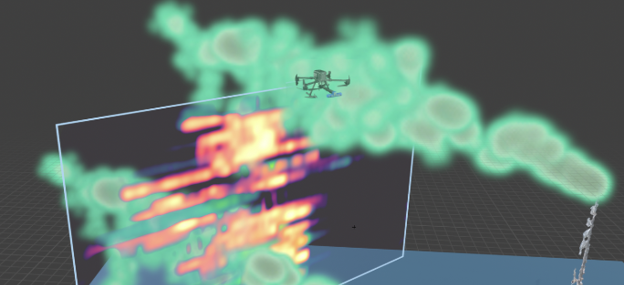
Drone-based methane measurement can provide one option for conducting site-level measurements while also collecting spatial information about the emissions plume.
SeekOps’ SeekIR® technology measures methane concentrations from a UAV while collecting environmental parameters used in quantification, including wind conditions, temperature and pressure. Measurements are used to construct a flux plane downwind of the facility or emission source, allowing methane mass flux through the plane to be quantified. This method is generally referred to as the mass balance approach.
Importantly, the measurement produces more than an emissions-rate estimate. SeekOps’ Dynamic Uncertainty methodology propagates measurement and environmental uncertainties through the quantification process to provide measurement-specific uncertainty alongside the result.
That combination of site-level quantification and uncertainty characterization can provide data that operators can incorporate into broader Level 5 measurement and reconciliation programs.
The distinction is important: a measurement technology does not, by itself, make an asset “Level 5.” Level 5 is a reporting and reconciliation process undertaken by the operator. Measurement technologies provide some of the empirical information needed to support that process.
From Level 5 Reporting to Better Methane Management
The value of measurement-based reporting extends beyond satisfying a reporting framework.
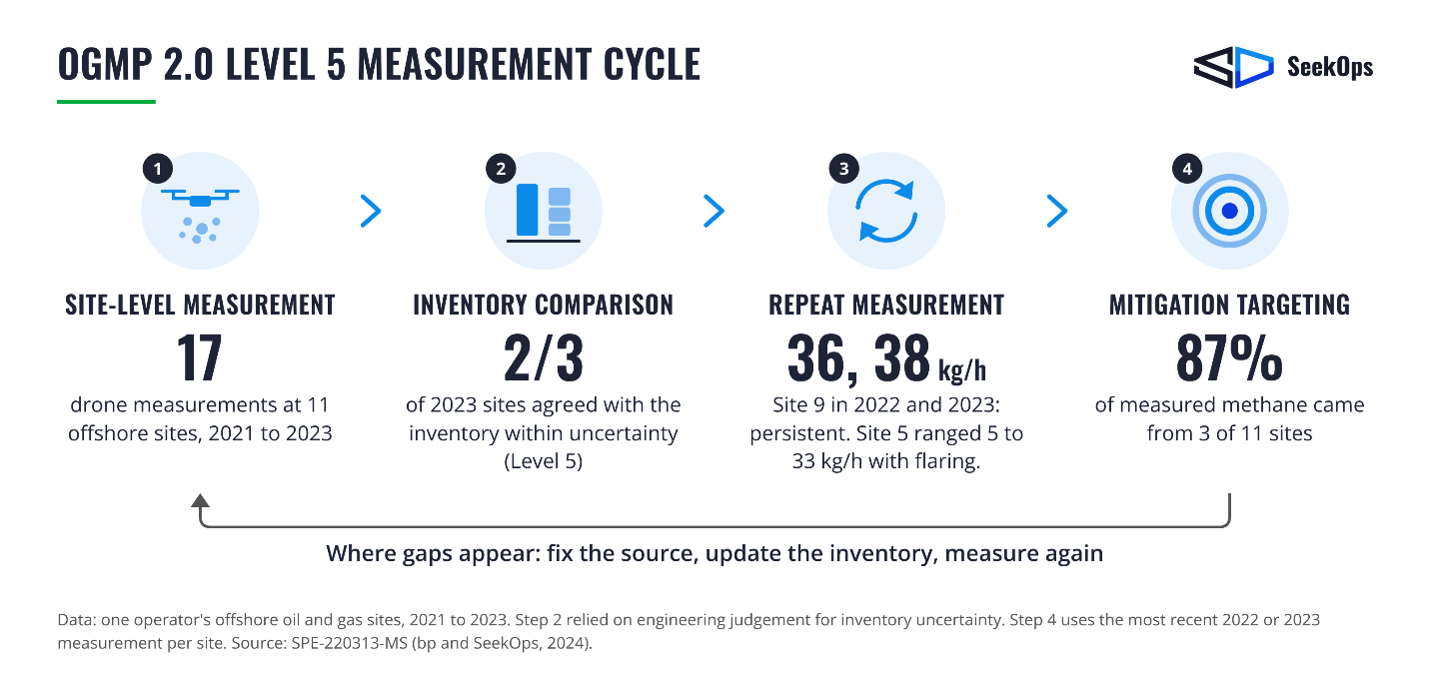
When site-level measurements are compared with detailed source-level inventories, operators gain another way to test whether their understanding of facility emissions reflects measured conditions. Repeated measurements can add further context by showing whether emissions persist over time, appear intermittently or change following operational or mitigation activities. (For a real-world example of how repeat measurements and reconciliation can support methane management, explore our case study, OGMP 2.0 Level 5 Measurement and Methane Management.)
This is ultimately where measurement-based frameworks such as OGMP 2.0 can become useful operational tools rather than simply reporting exercises.
UNEP describes better emissions understanding as a way for companies to target mitigation toward the largest actual methane sources. OGMP 2.0 data also undergoes UNEP review for completeness, consistency and conformity, alongside broader data analysis intended to identify trends and potential anomalies.
OGMP 2.0 in a Changing Methane Policy Landscape
OGMP 2.0 itself remains a voluntary framework, but the broader policy environment around methane measurement is evolving.
Governments are increasingly considering measurement-based approaches to methane MRV, and UNEP has specifically developed guidance for policymakers interested in incorporating OGMP 2.0-aligned reporting into regulation.
The European Union’s methane requirements provide one particularly important example of the growing emphasis on measurement, reporting and verification across international oil and gas supply chains.
(Learn more about what the EU Methane Regulation means for oil and gas operators and exporters in our blog, Understanding the EU Methane Regulation.)
For operators, this convergence makes the ability to generate credible, transparent and repeatable methane measurements increasingly useful across voluntary reporting, regulatory reporting and emissions-management programs.
Preparing for the Next Reporting Cycle
OGMP 2.0 reporting is an annual process. Member companies submit their annual report by May 31 using data from the previous year, meaning the measurements and emissions information gathered throughout the current year ultimately form the basis for future reporting.
As the year comes to a close, operators therefore have an opportunity to look beyond the reporting deadline itself and assess the underlying data they have collected.
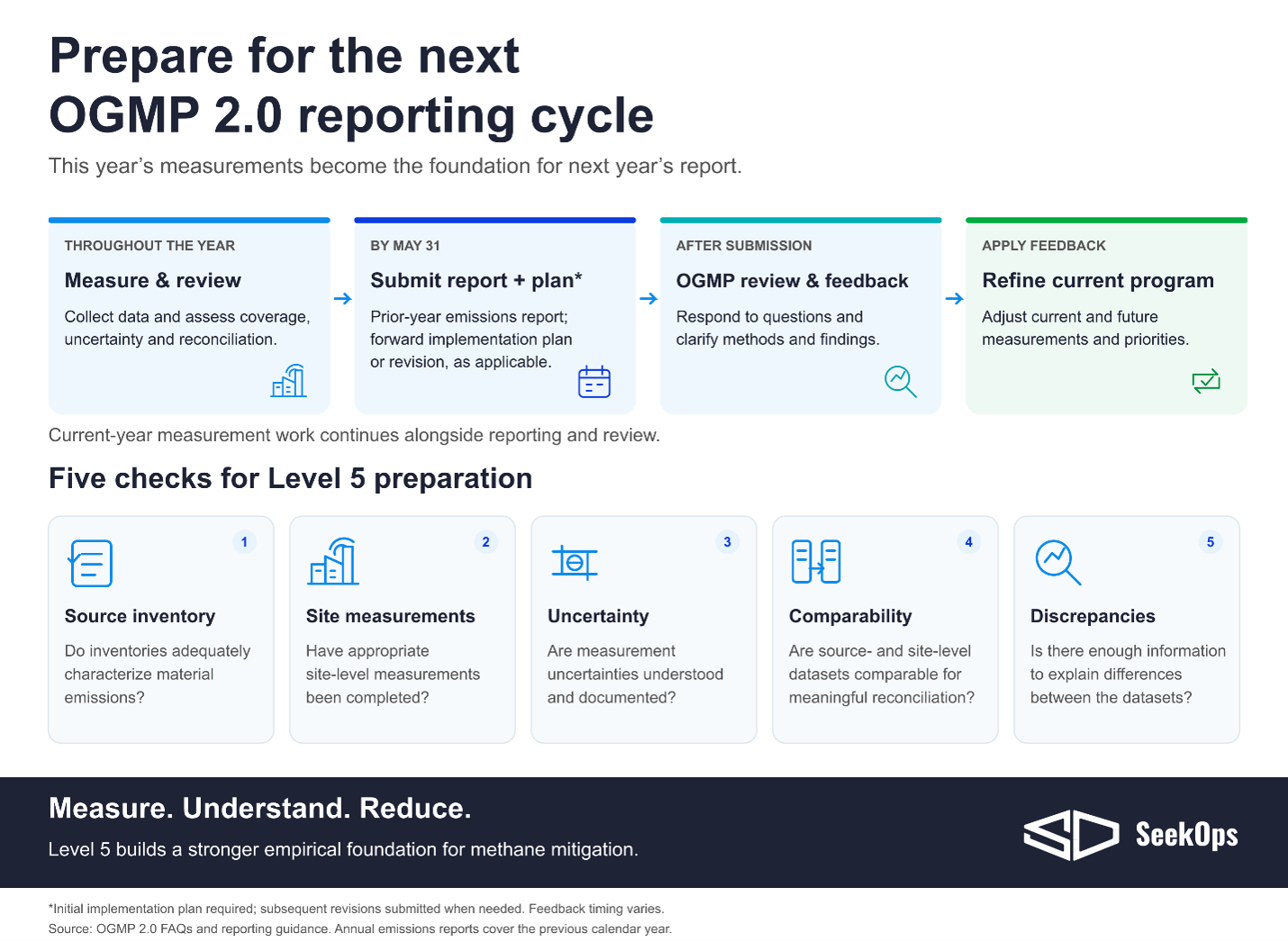
Do source-level inventories adequately characterize material emissions? Have appropriate site-level measurements been completed? Are measurement uncertainties understood? Are the source- and site-level datasets sufficiently comparable for meaningful reconciliation? And where discrepancies exist, is there enough information to understand why?
For companies progressing toward OGMP 2.0 Level 5, answering those questions is part of the larger transition from estimating methane emissions to understanding them through measurement.
And ultimately, that is the value of Level 5: not simply producing another emissions number, but building a stronger empirical foundation for finding, understanding and reducing methane emissions. Navigate to our contact page if you would like to discuss OGMP 2.0 in further detail or would like to chat with a regional sales manager to see if SeekOps is the right fit for your emissions inventory needs.
References
European Parliament and Council of the European Union. (2024). Regulation (EU) 2024/1787 on the Reduction of Methane Emissions in the Energy Sector. https://eur-lex.europa.eu/eli/reg/2024/1787/oj/eng
Stocker, I., Evans, P., Jupp, M., Bose, R., & Smith, B. (2024). Reconciliation of Source-Level Methane Emissions Measurement with Site-Level Measurement Using a Drone-Mounted Sensor: New Insights for Standardisation and Global Deployment. SPE International Health, Safety, Environment and Sustainability Conference and Exhibition. https://doi.org/10.2118/220313-MS
United Nations Environment Programme (UNEP). (2020). Oil and Gas Methane Partnership (OGMP) 2.0 Reporting Framework. https://ogmpartnership.com/wp-content/uploads/2023/02/OGMP_20_Reporting_Framework-1.pdf
United Nations Environment Programme (UNEP). (2024). OGMP 2.0 Starter’s Guide. https://ogmpartnership.com/wp-content/uploads/2024/08/OGMP-2.0-Starters-Guide-May-2024.pdf
United Nations Environment Programme (UNEP). (2025). Blueprint for MRV: How Countries Can Build OGMP 2.0-Aligned Reporting into MRV for Methane. https://www.unep.org/resources/report/blueprint-mrv-how-countries-can-build-ogmp-20-aligned-reporting-mrv-methane
United Nations Environment Programme (UNEP). (n.d.). OGMP 2.0 Guidance on Uncertainty and Reconciliation. https://ogmpartnership.com/wp-content/uploads/2023/02/OGMP-2.0-UR-Guidance-document-SG-approved.pdf
United Nations Environment Programme (UNEP). (n.d.). Oil and Gas Methane Partnership 2.0. https://methanedata.unep.org/oil-gas-methane-partnership
United Nations Environment Programme (UNEP). (n.d.). Oil and Gas Methane Partnership 2.0: Frequently Asked Questions. https://methanedata.unep.org/frequently-asked-questions
